Dr Zafiirah Hosenie From reading the stars to measuring how AI sees.
I evaluate vision-language models (VLMs) that understand meetings and the people in them: what they see, what they miss, and why. Before that I built 3D Gaussian splats and avatar technology at Microsoft, and machine-learning pipelines that still run on the MeerKAT and MeerLICHT telescopes. Outside work, I'm learning quantitative trading and exploring agentic evaluation.
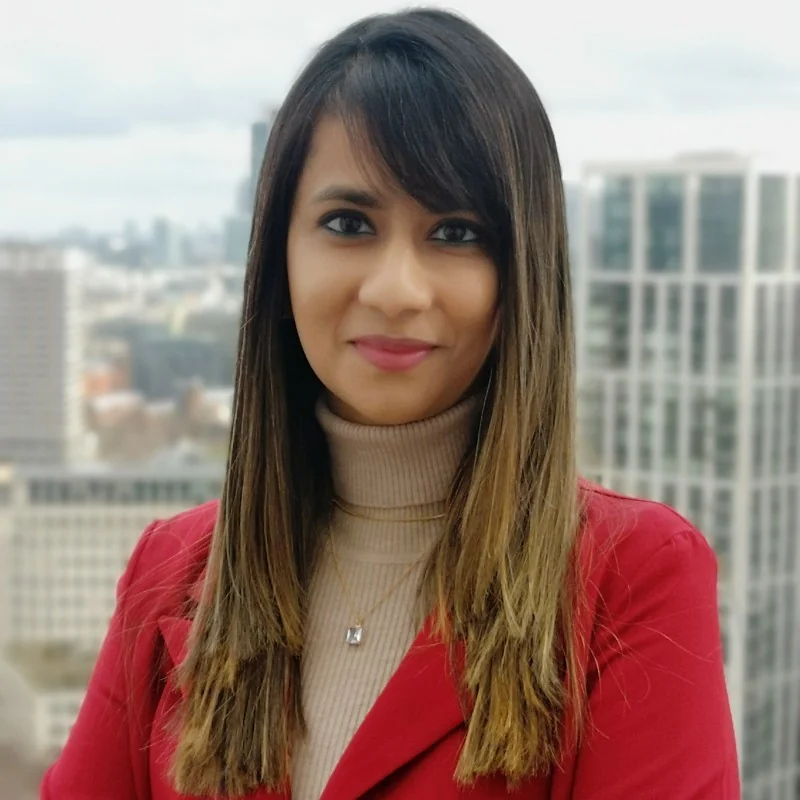
"It's not important what people think when you come in, it's much more important what people think when you leave."
My journey
I grew up in Mauritius, a small island in the Indian Ocean, where I fell for physics long before I knew what machine learning was. After a BSc in Physics at the University of Mauritius, I won SKA and North-West University bursaries for an MSc in Astrophysics & Space Science in South Africa, where I was the first to use a GAN to augment radio-astronomy images.
A Newton Fund DARA Big Data scholarship (one of only three) took me to Jodrell Bank, University of Manchester, for my PhD. The pipelines I built there run on the MeerKAT and MeerLICHT telescopes, and my thesis won the Institute of Physics Computational Physics Thesis Prize.
Then I moved from stars to people: climate risk at a FinTech, then Microsoft Research Cambridge (face tracking, synthetic data, Gaussian splats and avatars for Microsoft Mesh), and now VLM evaluation in the Teams AI Lab.
Curious by default
Stars, faces, 3D, markets: I follow interesting data wherever it leads.
Evidence over vibes
If it isn't measured, sliced and stress-tested, it isn't finished.
Lift as I climb
Mentor to women in data science; WomenTech Network Global Ambassador.
Island roots
Proudly Mauritian, shaped by three continents and many teams.
Experience & Education
Vision & multimodal
3D & generative
Evaluation & metrics
ML & statistics
Quant (learning)
Data & tools
Research & publications
Enrollment quality
Quality scores, outlier metrics and dashboards for meeting-room devices, replacing manual enrollment.
Identity & tracking metrics
False positives and negatives under occlusion, head pose, resolution and frame rate.
VoluMe: live 3D video calls
Real-time Gaussian splats of people from a single webcam.
Avatars from synthetic data
Fairness-aware hairstyles and markerless capture, feeding auto-generated avatars.
My work on 3D Gaussian Splatting at Microsoft: what splats are, how to compress them, and what I measured. Click a card to read.
MSc, PhD and FinTech work. Each card opens a short summary with the key results.
Learning in public: Diffusion models · Vision Transformers · NLP · FRGAN
AI that's measured, not assumed
A vision-language model can describe a meeting fluently and still miss who is speaking, invent an object, or fall apart when the camera is far away. My job is to measure what it gets right, where it fails, and why.
Define "good"
A clear task and rubric for each meeting scenario.
Test on real scenarios
Representative video: rooms, lighting, camera distance, number of people.
Score what matters
Perception, grounding, reasoning over time, and hallucinations.
Slice the results
Break down by occlusion, head pose, resolution and frame rate to find real failure modes.
Calibrate and track
Check automatic judges against people, then track everything on dashboards.
Sample slice report
Same model, same questions, different conditions. An overall score of 0.82 hides a much weaker tail.
Illustrative example of how I present results, not real data.
Interest Agents plan, call tools and loop, so they need more than output grading. Here is the framework I use to think about it, built from public Hugging Face and LangChain material. Click a card to read.
Role & context
Give the model a clear persona, audience and constraints. Ambiguity in, ambiguity out.
Few-shot examples
Curated, diverse examples, including edge cases, that show the behaviour I want.
Decompose & reason
Break tasks into steps; ask for reasoning where it measurably helps, and verify it.
Structured outputs
JSON schemas and typed fields so outputs are parseable, testable and easy to compare.
Visual prompts
For VLMs: say which frames, regions or people matter, and ask for evidence from the image.
Rubrics & judges
Judge prompts with explicit rubrics, checked against people before they're trusted.
Prompts are code: version them, test them, and never ship one without a regression suite.
Classic NLP
NLTK & spaCy pipelines.
Applied NLP
Matching power-plant names for climate risk.
Transformers
Mentoring NLP teams at Africa Women in Data Science.
LLMs & prompting
Building a prompt-engineering playbook.
VLMs & agents
VLM evaluation at work; agentic evals as an interest.
What I measure, then and now
Word frequency → Task success
Did the model actually do what the user needed?
Polarity score → Rubric-based judges
Automatic judges, checked against human ratings.
N-gram prediction → Visual grounding
Does the answer match what is on screen?
Subjectivity → Hallucination rate
How often does it describe things that aren't there?
The Quant Lab
Annualised Sharpe ratio: my runs
Out of sample where applicable. Higher is better.
What the numbers taught me
Risk-adjusted beats raw
Volatility targeting cut returns from 23% to 13% but lifted Sharpe from 0.58 to 0.85.
Baselines are brutal
Equal-weight long-only (0.79) beat long-short momentum (0.07).
Check behaviour, not only PnL
My deep momentum net learned a small, steady long bias: drift, not timing.
Respect time and regimes
Walk-forward validation, lagged signals, and the COVID-19 crash exposed an overfit model.
Volatility-targeting simulator
Simulates a GARCH(1,1) market and compares buy and hold with a strategy that scales exposure to hit a target volatility, using only past data.
The blog
Impact & community
Let's make something people remember after they leave.
Happy to chat about VLM evaluation, Gaussian splats, quant, speaking, or mentoring, especially if you're early in your data-science journey.
📍 Based in the UK · originally from Mauritius 🌴